
Session 1, Read and notice: A map can hold a family story
Week 12 big question: What can our records show? What do we still not know?
Start with a story (optional) Tara Finds Her Stars — Read it hereSupporting match · Tara, a photographer, travels by train and boat to her ancestors’ village.
Families move or stay in many ways.
A blank space on a family map can leave you wondering. Where did an ancestor, someone from an earlier family generation, live? A family journey may cross an ocean or go between nearby towns. Other families stay in one place for years and years. So there is no one pattern. Some people know many places an ancestor lived, while others know only a few. You can keep private or unknown places off your map.
Draw only the moves that sources show.
To show a known family move, draw an arrow on a map. It links a family’s earlier home with where the family lives now. More arrows can show more steps if sources back up each one. But the line cannot prove which road or ship route someone took. Add dates and a timeline to show when those moves happened.
Use sources, and say what you do not know.
Why did they move? Historians ask how people came to a community to learn about those reasons. People have moved for work, family, safety, learning, and other reasons. Some were forced to move, so we must not guess about one family. With permission, use a source, like an interview or photo. Say where it came from. If you are uncertain, or not sure, mark what you do not know. Your map can leave room for a question you hope to answer.
Grade 1 · Source card
Writing on the walls
Angel Island Immigration Station is in San Francisco Bay. From 1910 to 1940, many people who had just arrived were kept there. Officials had to decide if they could enter the country. An immigrant moves to live in a new country. Some Chinese immigrants carved poems into the walls. Their writing is a primary source. It is a clue made by people who were there. Look at the photo. What does it show? What would you need another source to explain?
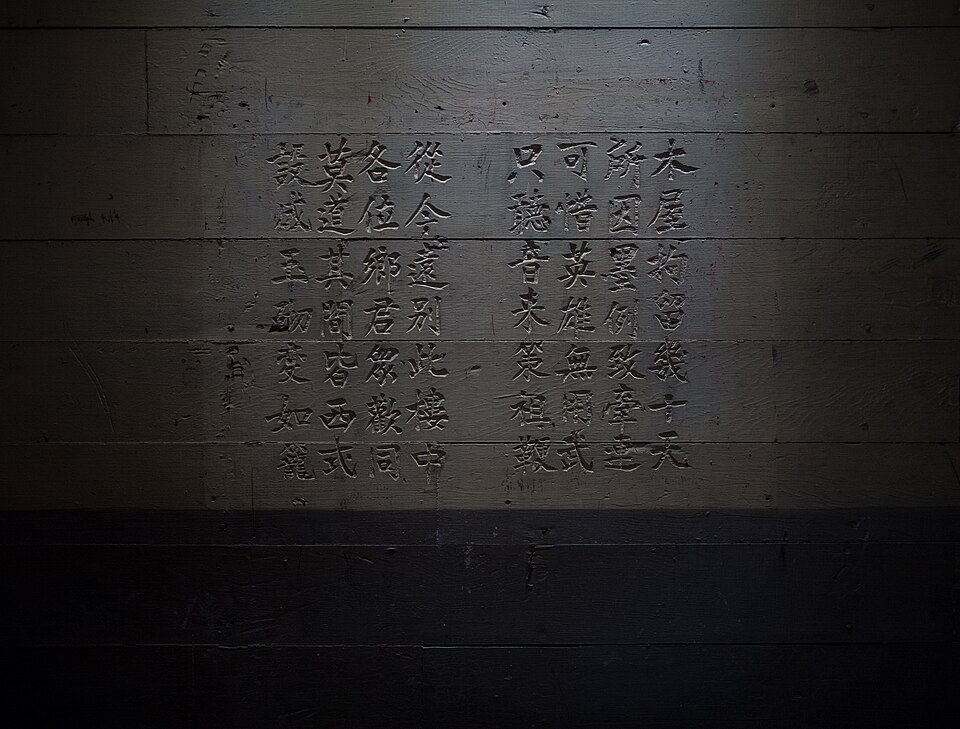
Angel Island Immigration Station wall. Photo: Rhododendrites, CC BY-SA 4.0 (https://creativecommons.org/licenses/by-sa/4.0/), via Wikimedia Commons. Source thumbnail; no further changes.
Image source · CC BY-SA 4.0
A clue in the wall writing. Draw or point to the writing. Tell one thing you see in the photo.
Sources for this card
Grade 2 · Source card
Writing on the walls
Angel Island Immigration Station is in San Francisco Bay. From 1910 to 1940, officials kept many arriving people there. They were deciding whether the people could enter the country. Some Chinese immigrants carved poems into the walls. Their writing is a primary source. It is evidence made by people who were there. Look closely at the photograph. What can it show? What would you need another source to explain?
Angel Island Immigration Station wall. Photo: Rhododendrites, CC BY-SA 4.0 (https://creativecommons.org/licenses/by-sa/4.0/), via Wikimedia Commons. Source thumbnail; no further changes.
Image source · CC BY-SA 4.0
My source record. Distinguish the old wall inscription from the modern photograph. Name one supported fact and one unanswered question about a journey.
Sources for this card
Show what you notice
- Why might a journey map leave some parts blank?
- What clues could show how a family came to live where it does?
Answer your waypointact it outtell or dictatewrite